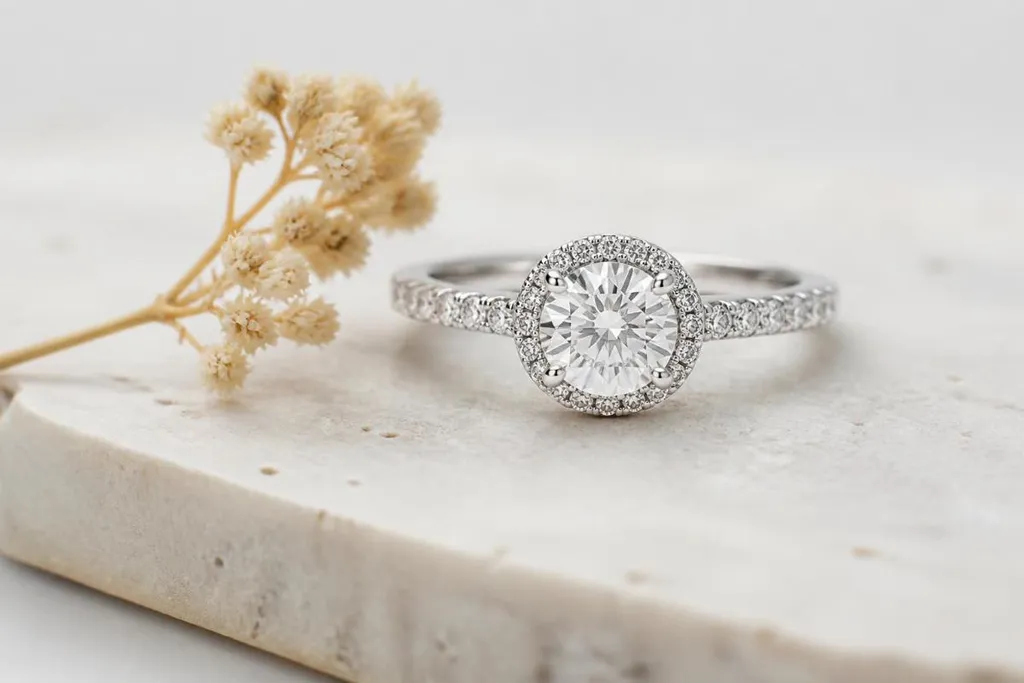
A halo can transform an engagement ring, but the most refined examples are not necessarily the largest or most conspicuous. Micro-pavé halos use exceptionally small diamonds set closely around the centre stone, producing a fine border of brilliance rather than a heavy frame. This precision can increase the visual presence of the centre while preserving its recognisable shape. For someone who likes a solitaire's clear focal point but wants greater intricacy and light, the approach offers a carefully balanced alternative.
Adding this upgrade is therefore less about simply increasing the number of diamonds and more about changing how the centre stone is presented. A well-proportioned micro-pavé halo can sharpen its outline, introduce contrast and create a more detailed face-up appearance without allowing the surrounding stones to overpower it.
What Makes a Micro-Pavé Halo Different?
A conventional halo surrounds the centre gemstone with smaller diamonds, but the scale and setting technique of those stones can significantly alter the result.
Micro-pavé uses particularly fine diamonds positioned close together. With less visually dominant metal separating them, the halo can read as a continuous line of light around the centre rather than a collection of individual accent stones.
This creates a delicate transition between the main diamond and the surrounding setting. From a normal viewing distance, the eye tends to register the increased brilliance first; closer inspection reveals the individual craftsmanship involved.
The effect is particularly suitable for someone who wants additional detail while retaining a refined profile. Larger halo stones can create a bolder, more decorative border, whereas micro-pavé tends to feel finer and more precise.
That distinction is important because a halo should complement the centre rather than become the primary feature.
Enhancing Size Without Losing the Stone's Shape
One reason halos remain popular is their ability to increase a ring's overall face-up presence. A micro-pavé version can achieve this while keeping the centre stone clearly identifiable.
Around an oval diamond, for example, a carefully fitted halo can follow the elongated outline rather than making the setting appear excessively broad. Round stones gain an additional circle of brilliance, while cushion, radiant and emerald shapes can have their distinctive geometry reinforced by accurately positioned accent diamonds.
Centre-stone size influences the balance. Someone choosing a 2-carat diamond may appreciate a micro-pavé halo not simply because it creates an even larger-looking ring, but because a substantial centre provides enough visual authority to remain dominant within a detailed setting.
With a smaller centre stone, the halo can contribute more significantly to the overall dimensions of the ring. In that case, especially fine accent diamonds may help preserve a clear distinction between centre and surround.
Proportion matters more than maximising apparent size.
How Metal Choice Influences the Halo
The metal holding micro-pavé diamonds is necessarily part of the design, even when very little of it is visible.
White gold and platinum can create a particularly cohesive appearance around colourless diamonds. Their cool tone visually blends with the stones, allowing the halo to appear bright and continuous.
Yellow gold produces greater contrast. Small sections of warm metal can remain visible between the diamonds, giving the setting a richer character and clearly distinguishing it from an all-white arrangement.
Rose gold creates a softer effect, introducing warmth around the centre while retaining the brilliance of the micro-pavé stones.
The centre setting and halo do not always have to produce identical visual effects. Thoughtful metal choices can make the centre appear more defined or allow the entire arrangement to merge into a unified field of sparkle.
The best option depends on whether the wearer prefers contrast or continuity.
Everyday Care for Fine Halo Settings
Micro-pavé involves numerous small diamonds and correspondingly delicate setting work, so regular care is worthwhile.
Soap, moisturiser and other residue can settle between closely positioned stones, reducing the crisp brilliance that gives a micro-pavé halo its character. Gentle cleaning helps prevent this accumulation.
Professional inspections are equally valuable. A jeweller can examine the small settings as well as the centre stone, checking for wear or movement that may not be obvious during everyday use.
It is also sensible to remove a finely set ring for heavy manual activities or situations involving repeated impact. Micro-pavé is intended to be worn, but considerate habits can reduce unnecessary stress on its smaller components.
Wedding-band compatibility should be considered too, as the shape and width of the halo may influence how closely another ring sits beside it.
Final Thought
A micro-pavé halo can give an engagement ring greater brilliance and presence without relying on oversized accent stones or heavy detailing. Its effectiveness comes from precision: small diamonds closely follow the centre stone, enhancing its outline while creating a finely illuminated border.
For someone seeking more visual impact while retaining an elegant sense of proportion, it offers a thoughtful refinement. Done well, the halo does not distract from the centre diamond—it gives that centre a more considered frame.